“Done!” is the cheapest thing an agent can write. Sometimes it means the feature works; sometimes it means the code compiles and the tests the agent wrote for itself pass. Two things fix this: a criterion you can check, written before the work, and a rule that the agent shows proof instead of closing the task itself.
#Why “done” drifts
An agent finishes when it believes the task is finished. Without a criterion, that belief rests on whatever it could check from inside the session: the build passes, its own tests are green. Whether the user can actually pay, or the page actually loads on a phone, often stays unchecked. The result is the familiar “done, but it doesn't work”.
#What a good “done when” looks like
One sentence, about something visible or runnable: a command, a scenario, a screenshot, a number.
Vague
- Payments work
- Improve the onboarding
- The site is fast
- Set up the server
Checkable
- A test card payment shows up as an order
- A new user reaches the first saved note in under a minute, on a phone
- The home page scores 90+ in Lighthouse on mobile
curl https://example.com/healthreturns 200 from the new server
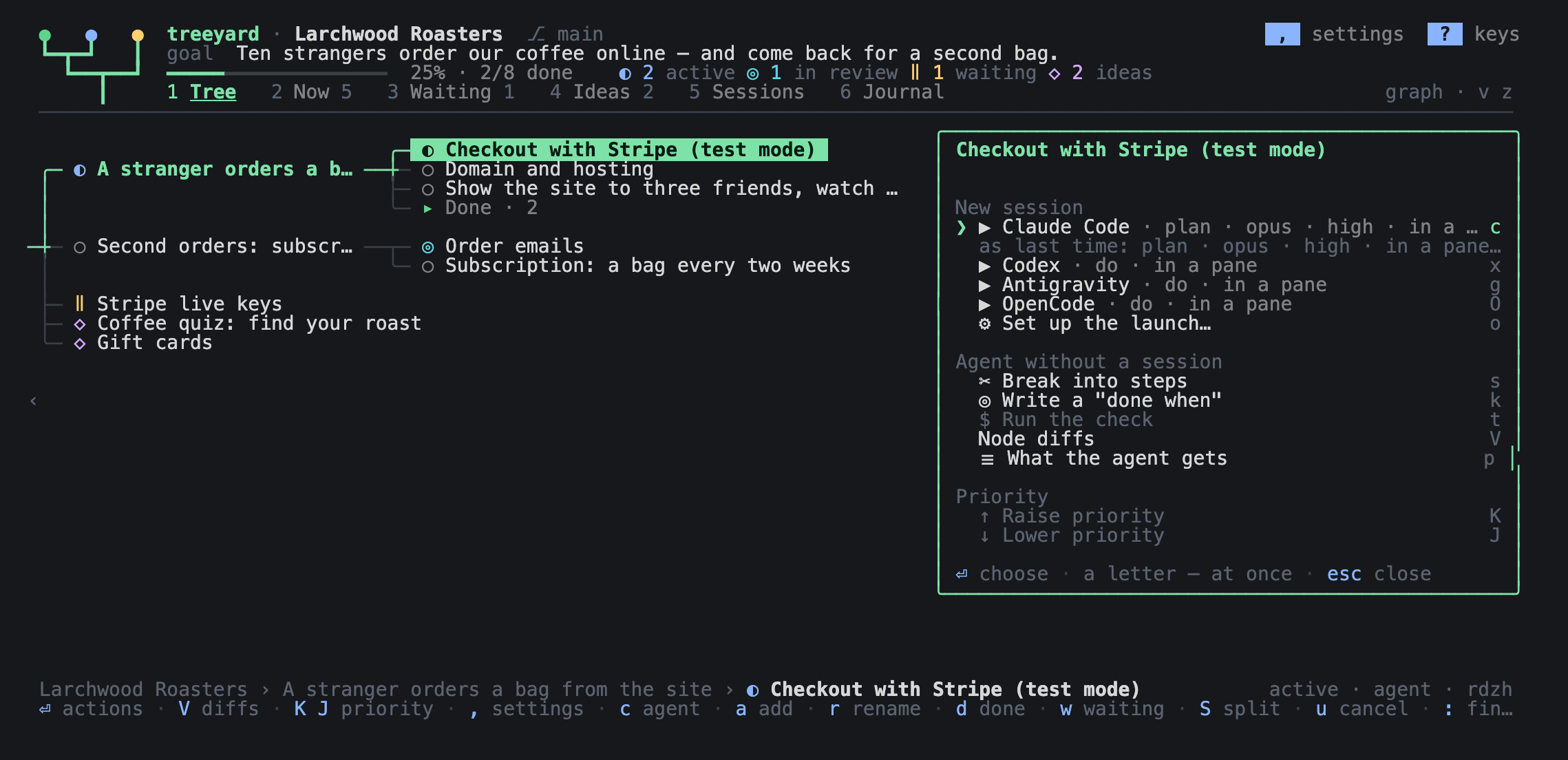
The first criterion on the right is taken from a real node in Treeyard's example tree, “Checkout with Stripe (test mode)”. Its card shows it right under the title.
#The agent shows proof, a person accepts
The agent works against the criterion
It gets the node's “done when” in its context from the first message.
It sets “in review” and attaches proof
A command and its output, a screenshot added to the node, its commits.
You look
V shows the node's diffs: everything its sessions committed.
You accept the work
d marks the node done. If it isn't done, it goes back with a journal entry about what is missing.
An agent can't skip the last step even if it tries: when an agent sets a node to done, Treeyard turns it into review by itself. That's by design.
Why it's worth the extra step
- “Done” means the thing works, not that the agent thinks so
- The proof stays in the node: a month later you can see what was checked and how
- A mistake is caught at review, not by a user
What it costs
- A minute of your time per node
- Criteria have to be written before the work, not after
Questions
Can another agent do the review?
What counts as proof for UI work?
treeyard image <id> shot.png --note "what it shows" attaches it to the node.