With Claude Code or Codex, the code of a project gets written in an evening. Then the project sits at “almost ready” for a month. The code is rarely the reason. What stops it is the work around the code that only a person can do, and a plan that no longer shows where the project stands.
#How it usually goes
You describe the idea, the agent writes the code, it runs on your machine. A week later:
- the plan has grown into a
PLAN.mdthousands of lines long, and every session starts by reading it; - you ask for one thing and get three more “while I was at it”;
- the agent says “done”, and it doesn't work;
- the server, the domain and the payment provider are still “for later”;
- you come back after a break and can't tell where you stopped.
None of this is about code. Agents are good at code. A project stalls at the point where the next step isn't code.
Code: done. Project: stuck.
#The steps no agent will take for you
Renting a server, buying a domain, getting live keys from a payment provider, signing a contract, showing the product to a stranger. Usually this is the last ten percent, and it is also the part that makes a project real. While these steps wait, the agents keep busy with side features, because side features are something they can do.
#Three rules that get a project past 90%
The root is a goal in life, not in code
“A stranger orders a bag of coffee on the site”, “for a week I run the channel only through the bot”. Tests say the code works; the goal says the project did its job.
A dead end is a waiting branch
Stuck on the bank or a lawyer, mark the node “waiting” with the reason and when to come back, and go work in another branch. The project hasn't stalled; one branch is waiting.
A new idea is a new node
Not “while I'm at it”. The idea isn't lost, and the stage you are in gets finished.
#Before and after
A plan in one file
- One
PLAN.md, read in full by every session - The agent ticks its own boxes
- Your own steps get lost among the items
- One thing is stuck, and the whole project waits
A goal tree
- Each task is a node with its own journal; an agent gets only its node
- The agent shows proof, and you accept the work
- Your steps are nodes marked “done by: you”
- One branch waits, the others go on
#Where Treeyard comes in
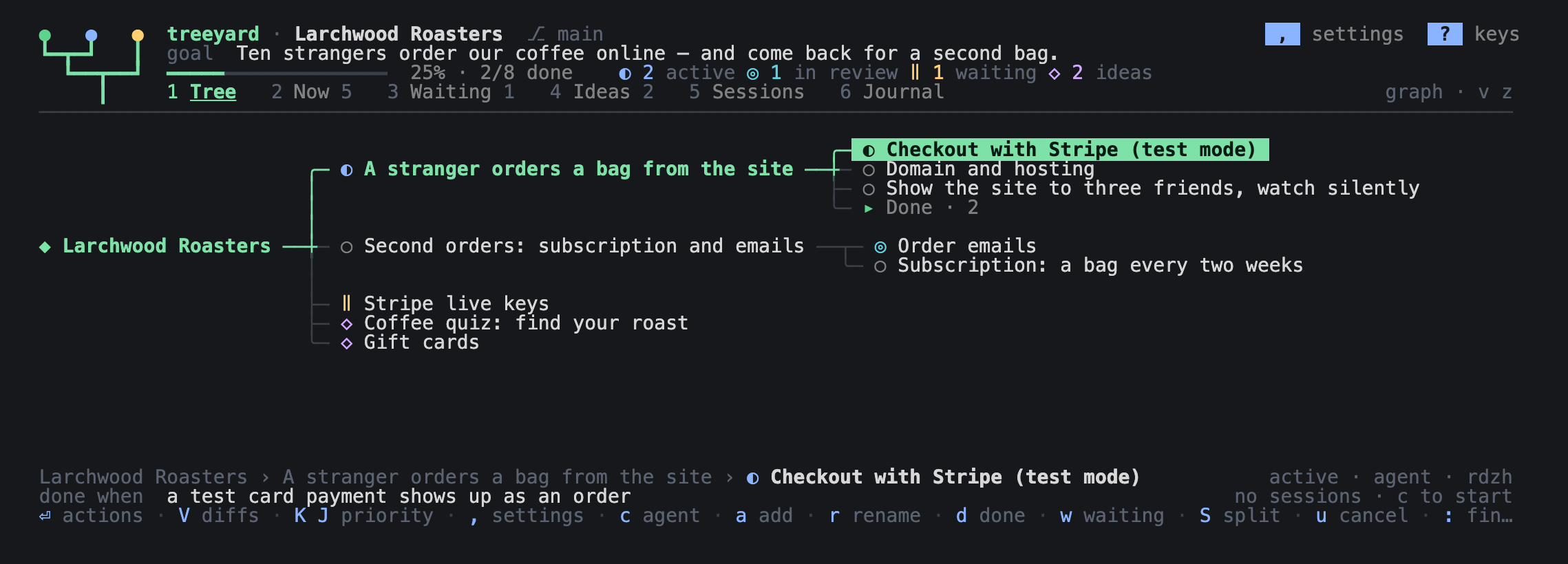
Treeyard is a goal tree in the terminal, on top of Claude Code, Codex, Antigravity and OpenCode. The goal is at the top, milestones under it, tasks under them. You start agents from the nodes, and the tree shows what is done, what is in progress and where things are stuck, with the reason. The tree is plain Markdown in .tree/, committed along with the code.
It grew out of exactly this problem, and Treeyard itself has been run by its own tree since the first commit. The twelve rules it rests on are on one page: How to run a project with agents.
npm install -g @antondanv/treeyard
cd my-project && treeyard        # no tree yet: the planting wizard